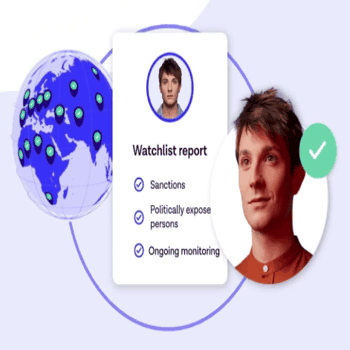
Why would I need a Global Watchlist Check?
A Global Watchlist Check is an essential part of a thorough background screening process for several important reasons:
1. Compliance with Legal and Regulatory Requirements
Many industries are required by law to ensure employees and partners are not associated with individuals or entities on government watchlists. This is particularly critical for financial institutions, healthcare providers, and organizations working with sensitive data or government contracts.
2. Mitigating Security Risks
Identifying candidates affiliating with terrorist organizations, trafficking networks, or other criminal activities helps protect your organization from potential security threats.
3. Protecting Reputation
Employing individuals with ties to illegal activities could damage your organization's reputation, harm customer trust, and attract negative media attention.
4. Safeguarding Against Financial Penalties
Non-compliance with global sanctions and regulations, such as those set by the U.S. Treasury's Office of Foreign Assets Control (OFAC) or international authorities, can result in significant fines and penalties.
5. Maintaining a Safe Workplace
Ensuring employees do not pose a risk due to affiliations with criminal or extremist groups promotes a safer and more secure working environment.
6. Global Business Considerations
This check ensures compliance with local laws and global anti-terrorism, anti-trafficking, and anti-corruption efforts for companies with international operations or partnerships.
How is the Global Watchlist Check conducted?
A Global Watchlist Check uses specialized tools and services to scan multiple databases and maintain government and international organizations' lists. Here's how the process works:
1. Obtain Candidate Consent
Before conducting a Global Watchlist Check, you must obtain written consent from the candidate, as required by laws like the Fair Credit Reporting Act (FCRA) in the U.S. and other global privacy regulations.
2. Collect Candidate Information
Key details are collected, such as:
Full name (including variations)
Date of birth
Social Security Number (SSN) or national identification number
Other identifiers (passport number, if applicable)
3. Access and Search Databases
The candidate’s details are compared against over 100 domestic and international watchlists. These databases may include:
Sanction Lists:
U.S. Office of Foreign Assets Control (OFAC) Sanctions
United Nations Security Council Sanctions
European Union Sanctions
HM Treasury (UK) Sanctions
Terrorist Watchlists:
FBI Terrorist Screening Center (TSC)
Interpol Notices
Trafficking and Criminal Watchlists:
U.S. Department of Justice lists
Human trafficking and child exploitation registries
Other Relevant Lists:
Politically Exposed Persons (PEPs)
Anti-Money Laundering (AML) lists
Denied Persons and Restricted Parties Lists
Advanced background check services often use algorithms to account for spelling, aliases, and transliteration variations.
4. Verify Results
Matches are analyzed to ensure they are not false positives. Factors like birth date, middle name, and other identifiers help distinguish candidates from unrelated individuals with similar names.
5. Generate a Report
A report is created detailing any matches found on the watchlists. The report includes:
The specific list or database where the game was found.
The reason for the inclusion on the list (e.g., terrorism, human trafficking, sanctions violation).
Any additional information is relevant to the match.
If no matches are found, the report will indicate that the candidate has cleared the watchlist check.
6. Review and Take Action
If matches are identified, further investigation is conducted to confirm accuracy. Employers then decide on appropriate next steps, including disqualification from hiring or escalating the matter to legal or compliance teams.
Is my consent required for Global Watchlist Check?
Yes, your consent is typically required for a Global Watchlist Check.
Under federal laws like the Fair Credit Reporting Act (FCRA), employers must obtain written permission to conduct background checks and drug tests. You will be asked to sign authorization forms outlining the checks and your rights, including how the information will be used.